
Penticton Apartment Cap Rates Explained:
What Owners and Investors Need to Know
Introduction
If you own a rental apartment building in Penticton, or you're thinking about buying one, you've probably heard the term "cap rate" thrown around. Maybe someone mentioned it in passing and you nodded like you knew what they meant. Or maybe you've looked it up and still aren't totally sure how it applies to your specific situation here in the Okanagan. Either way, this article is for you.
I've been appraising commercial and multi-family real estate in the Penticton area for years, and cap rates come up in almost every conversation I have with apartment owners and investors. So let me break it all down — what cap rates are, why they matter, what's driving them in this market, and what the actual sales data from Penticton tells us.
What Is a Cap Rate, Really?
Cap rate stands for capitalization rate. At its core, it's a simple formula:
Cap Rate = Net Operating Income (NOI) ÷ Sale Price
Net Operating Income is your gross rental revenue minus your operating expenses — things like property taxes, insurance, maintenance, management fees, and utilities you pay as the owner. It does not include mortgage payments, because cap rates are meant to measure the return on a property as if you paid cash for it.
So if a 12-unit building sells for $2,000,000 and generates $100,000 in NOI per year, the cap rate is 5.0%.
Simple enough, right? But here's where it gets interesting — and important.
Why Cap Rates Matter So Much
Cap rates are essentially the language investors and appraisers use to communicate value in income-producing real estate. They do a few things simultaneously:
1. They tell you what the market expects as a return. A 5% cap rate means the market is willing to accept $5 of income for every $100 of value. That expectation is shaped by interest rates, investor demand, local economic conditions, and how "safe" the asset is perceived to be.
2. They directly determine value. Flip the formula around: Value = NOI ÷ Cap Rate. This means if your building's income goes up, so does its value. And if cap rates in the market compress (go lower), values go up even without any change in income. This is why a lot of apartment owners who bought in 2017 have seen significant gains — rents went up and cap rates compressed.
3. They help buyers compare properties. A small building on Winnipeg Street and a large one on Lakeshore Drive are very different assets, but expressing them both as cap rates lets buyers quickly assess relative value and risk.
What Affects Cap Rates in Penticton?
Cap rates don't just float around randomly. Several factors push them up or down:
Interest Rates — This is probably the biggest one. When borrowing costs rise, investors need higher returns to make the numbers work, which pushes cap rates up (and prices down). When rates are low, investors accept lower returns, which compresses cap rates and drives prices up. The Bank of Canada's rate hiking cycle that began in 2022 had a real impact on how buyers approached apartment acquisitions, and that's reflected clearly in the sales data.
Value-Add Potential — This is something that surprises people when they first dig into the Penticton market. The buildings trading at lower cap rates in the 4% range are generally not new or high-end — they're older buildings where buyers see significant upside through suite renovations and rent increases. A savvy investor will accept a lower going-in return if they believe they can push rents materially over a 3–5 year hold by modernizing units as they turn over. The current income looks modest on paper, but the buyer is paying for what the building *can* become, not just what it is today.
Building Size — Larger buildings do tend to trade at lower cap rates for a few reasons. You can hire professional management cost-effectively, the income is more diversified across more units, and there are simply fewer buyers competing for large assets, which concentrates demand. That said, size alone doesn't tell the whole story — it's usually the combination of scale and value-add runway that drives the most competitive pricing.
Location — Proximity to amenities, Okanagan Lake, and downtown Penticton all influence cap rates. A well-located building with easy access to services commands a lower cap rate because investors are more confident about long-term tenant demand and the ability to push rents.
Vacancy and Rental Market Strength — Penticton has seen relatively low vacancy rates in recent years. Tight rental markets reduce the perceived risk of owning apartment buildings and reinforce buyers' confidence that value-add renovation strategies will actually work — renovated units will rent, and they'll rent quickly.
Building Condition and Deferred Maintenance — Counterintuitively, some deferred maintenance can actually be priced into a lower cap rate if buyers see it as an opportunity rather than a liability. That said, buildings with serious structural or mechanical issues beyond cosmetic upgrading will still attract higher cap rates to compensate for the risk.
Investor Competition — When there are more buyers than sellers, competition drives prices up and cap rates down. The pandemic era saw a surge of investor interest in secondary markets like Penticton, and that enthusiasm — while it has cooled somewhat — hasn't disappeared.
Penticton Apartment Sales: The Data
Below is a summary of apartment building sales in Penticton from 2021 through 2025, organized chronologically. I've excluded street numbers for confidentiality, but this gives a clear picture of where the market has been and where it sat heading into 2026.
2021 Sales

2021 was an active year. Rates were near historic lows and investor appetite was strong. The 3.60% cap rate on Nanaimo Ave W is notable — that buyer was clearly pricing in significant value-add potential on top of an already competitive market environment.
2022 Sales

Only one recorded Penticton apartment sale has been presented, this is not the complete data set for 2022 but it’s important to note — the Bank of Canada began its rate hike cycle in March of that year, and buyer hesitation started creeping into the market.
2023 Sales
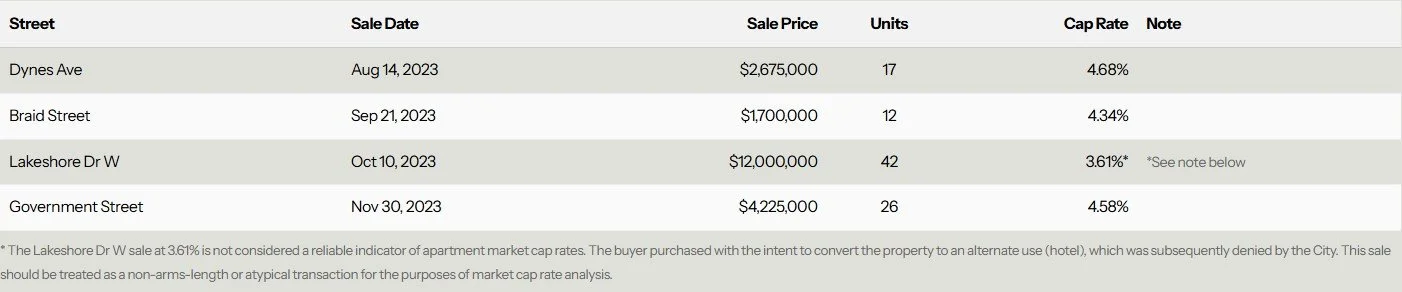
The Lakeshore Dr W sale requires some context. On paper, a 42-unit building trading at 3.61% looks like a sign of aggressive investor demand for premium lakefront assets — but that's not the full story. The buyer purchased with the intention of converting the property to a hotel, which means the price reflected an alternate use value rather than what a typical apartment investor would pay. That rezoning was subsequently denied by the City, making this sale an outlier that shouldn't be used as a benchmark for apartment cap rates in Penticton. Stripped of that sale, the 2023 data tells a more consistent story — multi-family assets with value-add potential were trading in the mid-to-high 4% range.
2024 Sales

2024 saw more transaction activity and a clearer spread emerging between asset types. The 5.42% on Government Street and 5.30% on Westminster Ave reflect buildings where buyers had less confidence in near-term rent growth or renovation upside — perhaps due to tenant mix, physical condition, or layout constraints. Meanwhile, buildings on Winnipeg and Wade Ave where the value-add thesis was more straightforward continued to trade in the low-to-mid 4% range.
2025 Sales

By 2025, the market had found a reasonably stable rhythm. The sub-4.5% cap rates continued to reflect buildings where buyers identified a clear path to higher rents through renovations and suite turnover. The 5%+ sales represent buildings where that upside was more limited or less certain. The two Lakeshore Dr W and Power Street sales in the spring of 2025 — both trading around 4% — attracted buyers who were willing to accept a lower going-in return because of the scale of the renovation opportunity across a larger number of units.
What the Trends Are Telling Us
Looking at this data heading into 2026, a few things stand out:
Cap rates have expanded from their 2021 lows. The sub-4% transactions of the early pandemic era would be very difficult to replicate today. The market has settled into a range of roughly 4–5.5%, with where a specific building lands depending heavily on its value-add potential, location, and size.
Value-add upside is the dominant pricing driver. This is the most important thing for owners and buyers to understand about the current Penticton market. A building with below-market rents and renovatable suites will attract buyers willing to pay more (accept a lower cap rate) than a stabilized building trading at current market rents with limited room to grow. If your building is already at the top of the rent range for its age and condition, don't expect it to trade like a value-add play.
The market is still active. Despite higher interest rates relative to the 2020–2021 lows, Penticton continues to see apartment transactions. There's genuine, sustained demand from investors — both local and from the Lower Mainland — who see the South Okanagan as a stable, long-term hold market with solid rental demand fundamentals.
What This Means If You Own an Apartment Building
Your property value is directly tied to two things — your NOI and the cap rate the market applies to it. You have more control over your NOI than you might think. Pushing rents to market through suite renovations as tenants turn over, reducing unnecessary expenses, and addressing vacancy are all ways to improve income and improve value.
But here's the flip side: if your building is already renovated and rents are at or near market, some of the premium that value-add buyers would pay simply isn't available to you anymore. The building is stabilized, and it will be priced accordingly. That's not a bad thing — stabilized income is valuable — but it's worth understanding how buyers will look at your asset.
Poor documentation of financials is another thing that will cost you at sale time. I see this regularly in appraisal work. A building with identical NOI to a comparable sale can trade at a meaningfully different cap rate if the income isn't well-supported or if there are condition concerns the buyer can't fully assess. Clean books and transparent operating history matter more than people realize.
What This Means If You're Looking to Buy
Buyers in today's market need to be honest about what they're underwriting. If you're paying a 4% or 4.5% cap rate, you need a credible plan to grow the income — because at current financing rates, the going-in cash flow is likely thin. That means being realistic about renovation costs, how quickly units will turn over, and what rents the market will actually support after renovation.
Be especially cautious about buildings where the value-add story is overstated. I've seen buyers pay low cap rates based on a rent roll that assumes every unit renovates for $15,000 and jumps $400/month — and the numbers just don't work out that cleanly in practice. Costs come in higher, turnover takes longer, and the as-renovated rents are sometimes more modest than projected.
A thorough income and expense review before making an offer is always money well spent. A formal appraisal that independently verifies the NOI and stress-tests the value-add assumptions gives you a much clearer picture of what you're actually buying.
Questions? Let's Talk
If you own a multi-family building in Penticton and want to understand what it's worth in today's market, or if you're a buyer trying to make sense of what you're looking at, I'm happy to help. As a local appraiser I work with both owners and investors to provide objective, well-supported valuations that hold up under scrutiny.
Cap rates are just one piece of the puzzle, but understanding them — and understanding *why* they are what they are in this specific market — is the foundation of making smart decisions.
Contact us today for expert multi-family services in Penticton and the South Okanagan:
RDOS Appraisals & Consulting
T: 250.490.5266
E: bryce@rdoscommercial.com
www.rdoscommercial.com
Bryce Witherspoon is a commercial real estate appraiser based in Penticton, BC, specializing in multi-family and income-producing properties throughout the South Okanagan: Penticton, Summerland, Oliver, Osoyoos, Okanagan Falls, Princeton, Keremeos and Naramata.